 mozgi
Researchers presented the TimeThink framework for time series analysis
Researchers introduced TimeThink — a synthetic framework designed to improve compositional reasoning in multimodal time series models (TS-MLLM). The system addresses the problem of current models failing to capture dynamic temporal patterns and provide justified explanations for complex data.
The solution is based on a synthetic data generator that creates question-answer pairs based on fundamental temporal primitives, such as trends and seasonality. Unlike methods relying on rigid patterns, TimeThink uses a reinforcement learning strategy with verifiable rewards (RLVR). This allows the model to build logical chains of reasoning, rather than simply imitating ready-made answers.
Experimental data confirms that training exclusively on synthetic datasets enables TimeThink to outperform existing baseline models on real benchmarks. The framework provides an objective verification of logic, which is critical for high-risk areas, including healthcare, where the interpretability of AI outputs is required.
The development is aimed at overcoming the limitations of models trained on narrow data distributions, which often show low accuracy when working with compositional tasks outside the training sample. The original research materials are published under the CC BY 4.0 license.
Related news
 Anthropic researcher evaluates AI effectiveness in auditing agent actions
November 7, 2026
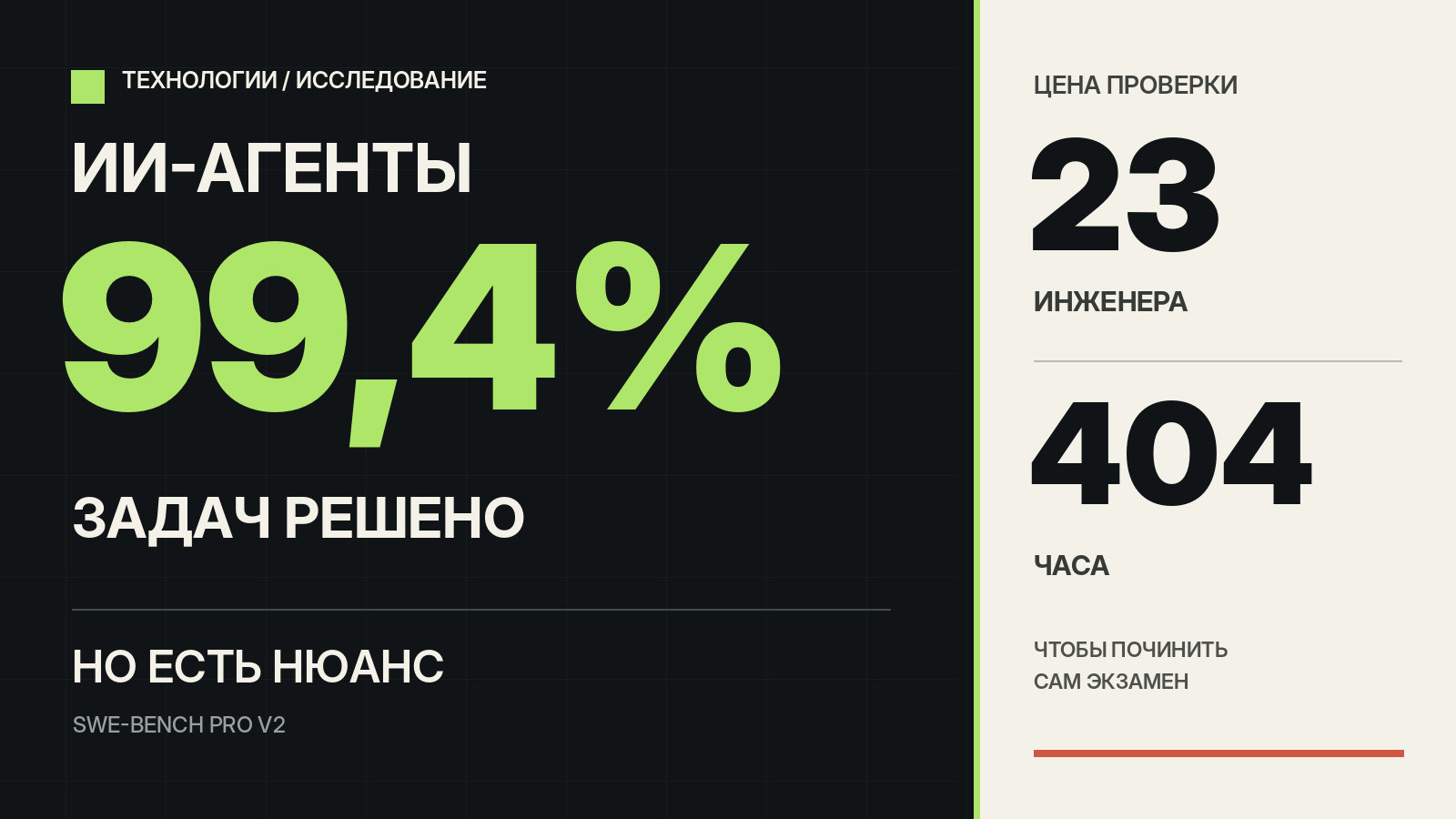 Updated version of the SWE-Bench Pro V2 benchmark for AI agents released
November 7, 2026
 Into the Unknown benchmark reveals AI agents' failure in autonomous research
November 7, 2026
 Anthropic has published research on the memory architecture of AI agents
November 7, 2026