 mozgi
Linum introduced the JiT-DDT architecture to accelerate model training by 3.6 times
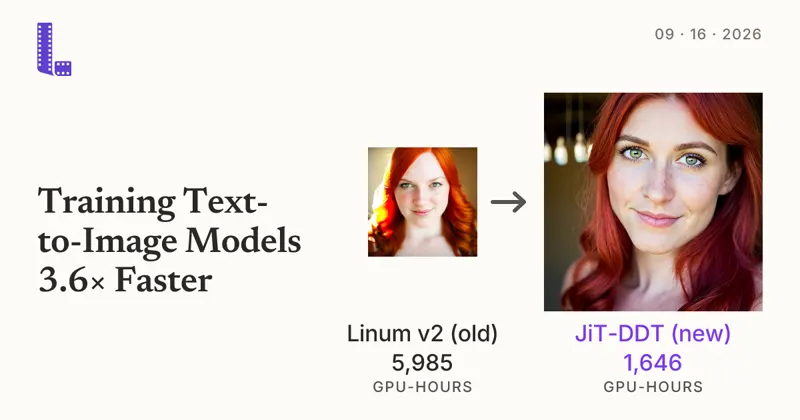
Company Linum announced a new JiT-DDT architecture designed to optimize the training process of generative models. The technology allows reducing the preparation time of neural networks for generating images from text descriptions by 3.6 times compared to standard Latent Diffusion Models.
The key difference of JiT-DDT is the rejection of the traditional "bottleneck" in the form of VAE (Variational Autoencoder). Instead, the architecture combines compression and generation processes into a single structure. The system applies aggressive token compression to a size of 32x32, which significantly reduces the computational load during training.
Developers note that this approach allows effective work with spatial data without losing the quality of the final generation. The integration of compression directly into the model architecture eliminates the need for preliminary data processing through external encoders, which often become a bottleneck when scaling training.
The new architecture is aimed at reducing the cost and development time of visual generative models. The use of JiT-DDT allows researchers and engineers to perform more training iterations on the same hardware, which is critical for creating high-performance image generation systems.
Related news
 METR recorded a twofold acceleration in AI development at Anthropic
November 6, 2026
 Researchers have introduced the OverclaimBench benchmark to test AI agents
November 5, 2026
 No model scored above 12% in the GDPx benchmark for AI agents
November 5, 2026