 mozgi
Researchers evaluated the effectiveness of the R-Lens method for Qwen models
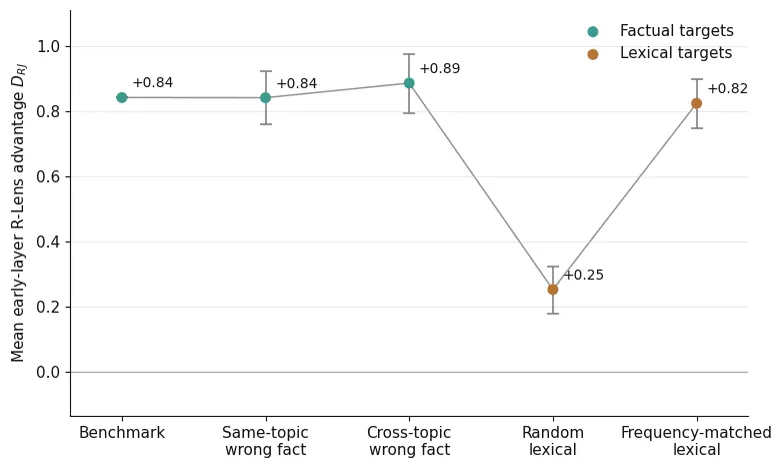
Researchers conducted testing of the R-Lens method, designed to extract hidden facts from the weights of language models of the Qwen family. During the experiment, the algorithm's ability to rank target words was evaluated in comparison to the existing J-Lens approach.
The results showed that R-Lens demonstrates higher ranking metrics for target tokens. However, control measurements revealed that the method's advantage directly correlates with word frequency in the training sample, rather than with the depth of extraction of specific factual knowledge from the model parameters.
As part of the work, the mechanisms of neuron activation during queries aimed at searching for hidden information were analyzed. It was found that statistical patterns of token distribution in Qwen have a greater impact on the result than the supposed "hidden knowledge" that the algorithm attempts to interpret.
This study questions the effectiveness of current interpretability methods based on direct fact-finding in weights. The obtained data indicate the need to consider frequency biases when developing tools for analyzing the internal structure of LLM.
Related news
 Anthropic researcher evaluates AI effectiveness in auditing agent actions
November 7, 2026
 Updated version of the SWE-Bench Pro V2 benchmark for AI agents released
November 7, 2026
 Into the Unknown benchmark reveals AI agents' failure in autonomous research
November 7, 2026
 Anthropic has published research on the memory architecture of AI agents
November 7, 2026