 mozgi
Researchers have adapted ethics training methods for Qwen models

A group of researchers has successfully replicated the Teaching Claude Why methodology, originally developed by Anthropic, for the Qwen 2.5 model family. The goal of the experiment was to reduce the likelihood of undesirable or "agentic" behavior in neural networks by changing their fine-tuning approaches.
During the study, two methods were compared: training on transcripts with ethical advice (SFT) and training on fictional stories (SDF). The results showed that the SFT approach is significantly more effective at minimizing the risks of unpredictable model behavior. Furthermore, the choice of the "teacher"—the model whose responses were used to form the training dataset—proved to be a critical factor for success.
The research confirms that the quality and nature of fine-tuning data play a decisive role in shaping a model's "ethical compass." Using specialized datasets with clear arguments for specific decisions allows for better control over Qwen 2.5 behavior than using literary texts with moral subtext.
The findings provide developers with a concrete algorithm for improving the safety of open models. Teams working with Qwen can now use this method to tune their systems, relying on the selection of the most suitable teacher model to generate training examples, which reduces the likelihood of dangerous patterns in agent behavior.
Related news
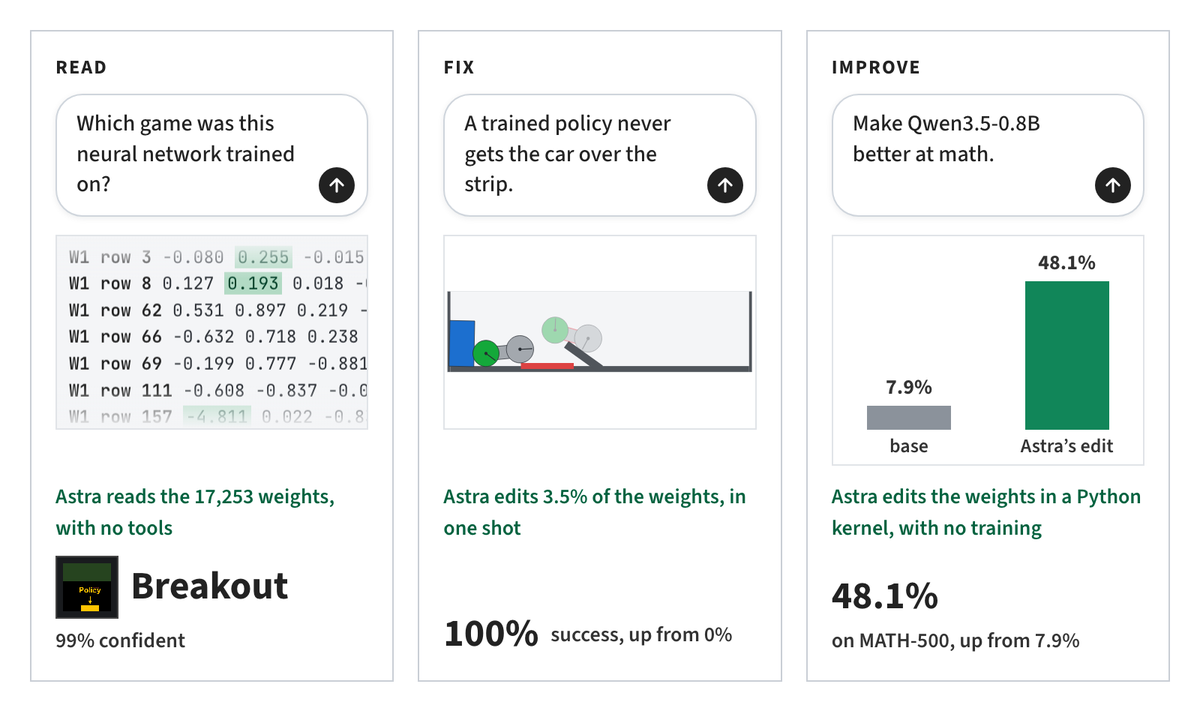 Researchers have introduced a method for direct modification of neural network weights
November 2, 2026
OpenAI has introduced the LifeVal benchmark for evaluating AI household tasks
November 2, 2026
 OpenAI has introduced the GPT-Rosalind-6 model for the life sciences
November 2, 2026