mozgi
GPT Image 2.0
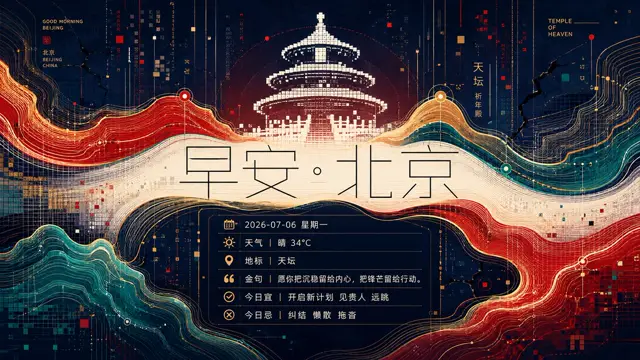
以北京天壇為主題的電影感海報,融合古老建築、數位圖像與中國書法, 製作
以北京天壇為主題的電影感海報,融合古老建築、數位圖像與中國書法,使用 GPT Image 2.0 製作
提示詞
目標:創作一張以北京為主題的每日問候卡,採用電影感橫式海報構圖,融合中國古代建築、未來感資料視覺化,以及優雅的實驗性字體設計。

畫布:寬幅 16:9 橫式構圖,背景採用深海軍藍工程藍圖風格,帶有低調的紙張紋理、裂痕、網格線、微小方塊、垂直技術標記,以及發光的電路般細節。使用精緻、高對比的深藍、象牙白、朱紅、青綠和暖金色調。

主體:在上方中央放置一個發光的像素藝術/馬賽克風格天壇剪影,以白色與暖金色發光,後方帶有淡淡的紅色光暈。在建築周圍加入纖細的垂直輔助線與零散的數位方塊。

字體設計:中央設計一條寬闊流動的象牙白緞帶,形狀宛如河流或絲帶。在緞帶上放置大型標題 早安·北京,採用極細、極簡的中文字體,字距寬廣,風格幾何、優雅而現代。標題應主導整張海報,同時保持輕盈雅致。

流動色帶:以層疊的地形等高線波浪環繞標題。恰好使用 4 組主要波浪系統:1 組紅金色波浪從左上方延伸至中央,1 組青綠金色波浪在右上方升起,1 組青綠色波浪沿著左下方掃過,另有 1 組紅金色波浪沿著右下方掃過。波浪由大量纖細平行的等高線、發光節點、小圓圈,以及地圖式測量標記組成。

資訊面板:在下方中央加入一張深色半透明圓角卡片,帶有細緻的金色邊框,並且恰好包含 5 列水平內容。每列左側放置一個小型金色圖示,右側放置中文字:
1. 日曆圖示:2026-07-06 星期一
2. 太陽圖示:天气 | 晴 34°C
3. 位置圖釘圖示:地标 | 天坛
4. 引號圖示:金句 | 愿你把沉稳留给内心,把锋芒留给行动。
5. 勾選與叉號風格圖示列:"今日宜 | 開啟新計劃 見貴人 遠眺" 和 "今日忌 | 糾結 懶散 拖沓",以視覺化方式排列為最後一行建議。

小型標籤:在角落和側邊加入英文與中文微型文字:左上方寫著 “GOOD MORNING BEIJING” 和 “北京 / BEIJING / CHINA”;右上方寫著 “TEMPLE OF HEAVEN”;右側附近加入垂直排列的中文字 “天壇 祈年殿”。所有微型文字都要小巧、具有技術感,並符合海報風格。

視覺風格:未來感中國編輯設計、資料藝術海報、奢華文化科技美學、精細線條、發光粒子、層疊地圖等高線、數位馬賽克紋理、低調的磨損裂痕、高細節、清晰字體、無人物、無浮水印、無額外標誌。
Goal: Create a cinematic horizontal poster for a daily greeting card themed around Beijing, combining ancient Chinese architecture, futuristic data visualization, and elegant experimental typography.

Canvas: Wide 16:9 landscape composition, dark navy blueprint background with subtle paper texture, cracks, grid lines, tiny squares, vertical technical markings, and glowing circuit-like details. Use a refined high-contrast palette of deep blue, ivory, vermilion red, teal, and warm gold.

Main subject: Place a luminous pixel-art / mosaic silhouette of the Temple of Heaven at the top center, glowing white and warm gold, with a faint red halo behind it. Add thin vertical guide lines and scattered digital blocks around the building.

Typography: Across the center, create a broad flowing ivory ribbon shaped like a river or silk band. On it place the large headline 早安·北京 in ultra-thin minimalist Chinese typography, widely spaced, geometric, elegant, and modern. The headline should dominate the poster while remaining airy and refined.

Flowing bands: Surround the headline with layered topographic contour waves. Use exactly 4 major wave systems: 1 red-and-gold wave crossing the upper left into the center, 1 teal-and-gold wave rising on the upper right, 1 teal wave sweeping along the lower left, and 1 red-and-gold wave sweeping along the lower right. The waves should be composed of many fine parallel contour lines, glowing nodes, small circles, and map-like measurement marks.

Information panel: At the lower center, add a dark translucent rounded rectangle card with thin gold borders and exactly 5 horizontal rows. Each row has a small gold icon on the left and Chinese text on the right:
1. Calendar icon: 2026-07-06 星期一
2. Sun icon: 天气 | 晴 34°C
3. Location pin icon: 地标 | 天坛
4. Quotation mark icon: 金句 | 愿你把沉稳留给内心,把锋芒留给行动。
5. Check and cross style icon row: "今日宜 | 开启新计划 见贵人 远眺" and "今日忌 | 纠结 懒散 拖沓" visually arranged as the final advice line.

Small labels: Add English and Chinese microtext in the corners and sides: upper left reads “GOOD MORNING BEIJING” plus “北京 / BEIJING / CHINA”; upper right reads “TEMPLE OF HEAVEN”; near the right side add vertical Chinese text “天坛 祈年殿”. Keep all microtext small, technical, and poster-like.

Visual style: Futuristic Chinese editorial design, data-art poster, luxurious cultural tech aesthetic, fine linework, glowing particles, layered map contours, digital mosaic texture, subtle distressed cracks, high detail, crisp typography, no people, no watermark, no extra logos.
此提示詞的權利屬於作者 @xiaoxiaodong01。任何商業使用(推廣 AI 工具、聚合平台、Telegram 機器人)由你自行負責,mozgi.io 不承擔任何責任。 詳情 →