mozgi
Seedance 2.0
The whole life of the poet Su Shi, from youth to old age, in one unbroken 30-second shot with the hero aging smoothly
Prompt
PROMPT:
Create a 30-second cinematic biographical video, filmed entirely as one completely seamless, continuous, uninterrupted long take. There must be no cuts, fades, dissolves, resets, or montage-like effects. The camera may orbit, track, dive, rise, rotate, pass behind foreground obstructions, and temporarily let the character be obscured, but the final result must always feel like a single moving shot that has never been interrupted.

**Core Concept**

A man’s entire life, from youth to old age, condensed into one uninterrupted long take. The man is Su Shi, the greatest literary figure of the Northern Song dynasty. He must remain the same person, a continuous presence throughout the film, while his age, face, build, hairstyle, clothing, expression, and bearing change fluidly as his life progresses. Every transformation must take place within the shot and be closely tied to his movement, with a clear physical cause.

His life must unfold seamlessly: a boy from Meishan becomes a young scholar traveling to the capital to sit for the imperial examination, then a rising young official, then a forthright official who opposes political reforms, then a prisoner caught up in the Literary Inquisition, then an open-hearted poet in the fields of Huangzhou, then a Hanlin academician returning to court, then a local governor administering Hangzhou, then an old man exiled to Lingnan, and finally a wise man who dies with a smile on his way back north. His face, build, beard, official robes or plain clothes, headwear or bamboo hat, and the objects he carries must all transition naturally with each stage of his life. These changes must happen in motion and must never be sudden jumps.

**Tone**

Poetic, majestic, heartfelt, open-minded, and imbued with the spirit of a literary scholar. The settings can be spectacular and dramatic, but the overall atmosphere must always carry Su Shi’s distinctive openness and warmth. Suitable for all ages, with no graphic violence.

**Audio Design (Seedance 2.5 Voice Format Instructions)**

This video uses Seedance 2.5 native audio generation, with visuals, voice, and sound effects created in sync in a single generation. Voice format rules:

- **Voice-over narration** (male voice reciting in a classical style): Enclose in double quotation marks "..." and precede with 「Voice-over recited in a steady, middle-aged male voice with a classical style:」

- **Ambient sound effects**: Mark with angle brackets <...>, e.g. <Wind rustling through a bamboo grove>

- **Background music**: Mark with parentheses (...), e.g. (Distant guqin melody, slow and deep)

- **Mixing priorities**: Keep the narration clear and prominent, background music lower in volume than the voice, and ambient sound effects as a subtle atmospheric layer

Since the spoken content is limited within 30 seconds (about 40–50 Chinese characters), select 6 of the person’s most representative poems or famous lines for the voice-over. Let ambient sound effects and background music carry the emotion in the remaining scenes.

**Narrative Arc of the Voice-over**

The 6 lines of narration should not only fit their respective scenes, but also form a complete spiritual arc when heard together:

1. “What is life like, wherever we may go? Like a wild goose leaving prints in snow.” → **Setting out**: Life is like a wild goose, never knowing where it will go

2. “I searched every branch, yet would not settle; alone and cold, upon the sandbar.” → **Falling**: Nowhere to roost, utterly alone

3. “Bamboo staff and straw sandals outpace the horse. Who’s afraid? Let me spend my life in wind and rain.” → **Awakening**: Letting go of everything, no longer afraid

4. “If I would liken West Lake to Xi Shi, she suits it equally in light makeup or rich adornment.” → **Finding peace**: Making peace with the world and loving what is before you

5. “I’d gladly eat three hundred lychees a day and remain forever a man of Lingnan.” → **Open-heartedness**: Wherever you go, you can find joy in life

6. “Wherever my heart is at peace, there is my home.” → **Homecoming**: Having traveled to the ends of the earth, wherever the heart is at peace is home

Heard together, these lines summarize the spiritual journey of Su Shi’s life: not knowing where he is headed → nowhere to roost → no longer afraid → loving the present → thriving wherever he goes → finding home in peace of mind.

---

## Opening: The Boy from Meishan (c. 1050, Su Shi at 13–14)

Open at dawn in Meishan, Sichuan.

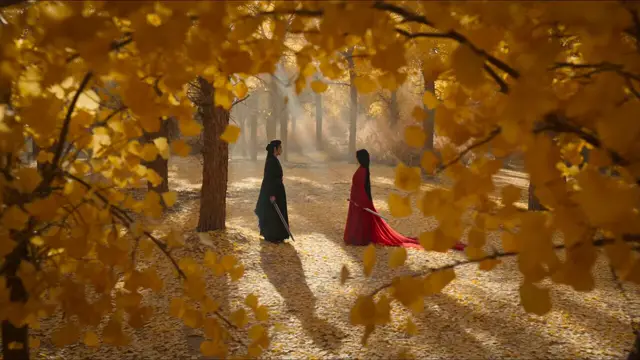
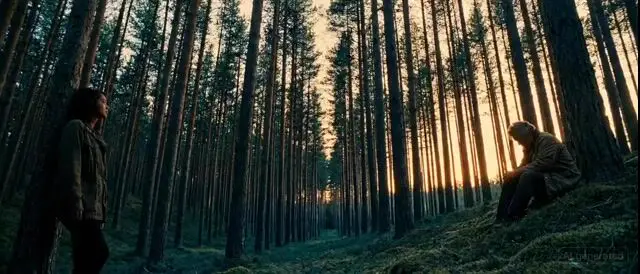
A boy stands on a hillside veiled by bamboo, overlooking the mist-shrouded Min River plain. In the distance are layers of green mountains; nearby, the upturned eaves of his father’s study. Morning light filters through the bamboo leaves and falls across his face. He holds a scroll of books in his hands, his eyes bright and curious. He has delicate features and wears the simple clothes of a young student from Shu; his hair is tied in the traditional children’s style. The image should establish an instantly poetic, cinematic atmosphere.

He hears a horn call in the distance (symbolizing the call of the imperial examinations), lifts his head, and a spark of light appears in his eyes.

<Wind rustling through the bamboo grove, a faint horn call in the distance>

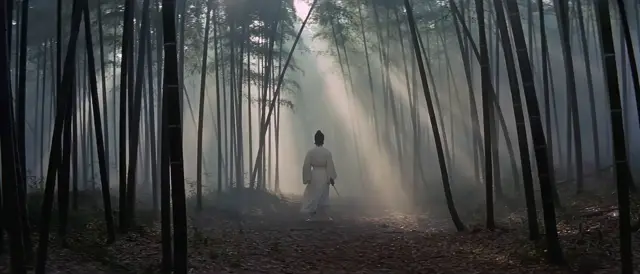
The camera begins to move as he turns and runs. He races down a narrow path through the bamboo.

---

## First Transformation: Boy from Meishan → Scholar Traveling to the Capital for the Imperial Examination (1056, age 20)

He runs through the bamboo grove, shadows from the leaves sweeping across him. As the shadows pass over him, his face matures slightly, he grows taller, and his childhood hairstyle becomes that of a young scholar with his hair tied up. His simple student clothes become the long travel robes of a scholar on his way to the examination. The scroll in his hands turns into a bundle.

The bamboo grove fades behind him, and the mountain path beneath his feet becomes the official road to Bianjing. The outline of a city appears in the distance. His stride is firm, full of the confidence of a young man setting out from Shu for the first time. The figure of his younger brother, Su Zhe, appears beside him, softly blurred as a background element.

Voice-over recited in a steady, middle-aged male voice with a classical style: “What is life like, wherever we may go? Like a wild goose leaving prints in snow.”

<Hoofbeats, wind along the highway>

---

## Second Transformation: Scholar Traveling to the Capital → Young Talent Who Passes the Imperial Examination with Honors (1057, age 21)

A banner billowing in the wind on the highway sweeps across the frame. As it passes over his body, his travel robes transform into the blue official robes of a newly successful jinshi. The bundle disappears, and a scroll bearing an imperial decree appears in his hands. His gait becomes confident and spirited.

The road beneath his feet becomes the stone-paved streets of the imperial city of Bianjing. Towering palace buildings appear on either side, with red walls, golden tiles, and bustling crowds. He walks through the crowd with a triumphant, radiant smile. Sunlight falls on his youthful face; he is brimming with confidence and ambition.

<Crowd chatter, ceremonial music and drums in the distance>

---

## Third Transformation: Young Talent → Candid Official Who Submits a Memorial (1069–1071, around age 33)

A vermilion palace pillar sweeps across the foreground, briefly obscuring him. When he reappears from behind the pillar, his features are more mature, with a neatly trimmed short beard. His official robes have become darker and more richly patterned, and he wears a black gauze official’s hat. His expression shifts from carefree triumph to serious concern.

He strides quickly through the corridors of the court, holding a memorial in his hands. The surroundings grow oppressive, and the shadows of the columns stretch out. In the distance, notices about Wang Anshi’s reforms and the figures of officials arguing are faintly visible. His hurried, determined stride conveys his resolve to speak plainly.

<Rapid footsteps echoing through the empty corridors>

---

## Fourth Transformation: Candid Official → Prisoner in the Wutai Poetry Case (1079, age 42)

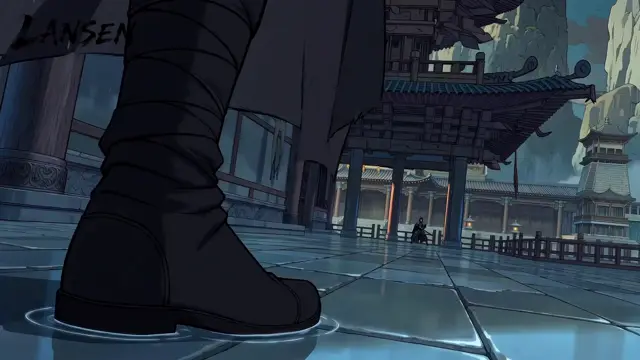
The light in the corridor suddenly darkens. The shadows of the pillars become the iron bars of a prison. His official robes lose their color in the darkness and turn into a prisoner’s coarse clothing. His black gauze hat disappears, and his hair becomes disheveled. The memorial in his hands turns into heavy chains.

His face grows haggard, his short beard becomes unkempt, and his eyes sink deep into their sockets. He stumbles through the dim cell, yet an unyielding light remains in his gaze. The walls are marked by water stains and scratches. A faint shaft of light falls from a small, high window onto his face.

Voice-over recited in a steady, middle-aged male voice with a classical style: “I searched every branch, yet would not settle; alone and cold, upon the sandbar.”

<Heavy chains dragging across the floor, water dripping and echoing>

The camera rises with the shaft of light.

---

## Fifth Transformation: Prisoner → Open-Hearted Poet in Huangzhou (1080–1084, around age 45)

The shaft of light grows wider and warmer, becoming moonlight over Red Cliff in Huangzhou.

The prison walls crack and fade away, becoming the rocks of Red Cliff beside the Yangtze. The prison floor beneath his feet becomes the riverside rocks. In the moonlight, his prison clothes turn into loose, plain scholar’s robes, tied at the waist with a coarse cloth sash. The chains disappear, and a flask of wine appears in his hand. His hair is tied up again, but no longer in an official style; instead, it is casually bound like a scholar’s and topped with a Dongpo headscarf.

His face relaxes. Though still thin, his eyes now shine with an open-hearted light. He stands beneath Red Cliff as the river wind stirs his robes. A small boat floats on the distant river. He tilts his head to gaze at the moon, his lips moving slightly as if reciting “The great river flows east.” He is completely freed from the oppression of prison, radiating a transcendent, unconstrained spirit.

Voice-over recited in a steady, middle-aged male voice with a classical style: “Bamboo staff and straw sandals outpace the horse. Who’s afraid? Let me spend my life in wind and rain.”

<River wind howling, waves crashing against the rocks>

He turns and walks along the riverbank, his steps unhurried.
制作一段 30 秒的电影级人物传记视频,全程必须是一个完全无缝、连贯、不间断的长镜头。不能有任何剪切、淡入淡出、叠化、重置,也不能有蒙太奇的感觉。摄影机可以环绕、跟踪、俯冲、升起、旋转、穿过前景遮挡物,也可以暂时让角色被遮住,但最终呈现的效果必须始终像一个从未中断的运动镜头。

**核心概念**

一个男人的完整一生,从少年到暮年,浓缩在一个不间断的长镜头中。这个人是苏轼,北宋最伟大的文人。他始终是同一个人,是贯穿全片的连续存在,但他的年龄、面容、体态、发型、服饰、神情和气质要随着人生阶段的推进而流畅地变化。每一次变化都必须在镜头内完成,并且和他的运动紧密相连,有物理上的因果关系。

他的演变必须无缝衔接:眉山少年变成赶考书生,再变成初入仕途的青年才俊,然后是反对变法的直言官员,接着是身陷囹圄的阶下囚,再到黄州田野间的旷达诗人,然后是重返朝堂的翰林学士,再到治理杭州的地方长官,然后是流放岭南的老者,最后是北归途中含笑而逝的智者。他的面容、身形、胡须、官服或布衣、头冠或斗笠、手中之物都要随人生阶段自然过渡。这些变化必须在运动中发生,绝不能是突然跳变。

**基调**

诗意、壮阔、深情、豁达、充满文人气韵。环境可以很壮观、很有戏剧性,但整体氛围始终带着苏轼特有的旷达与温暖。适合全年龄观看,不出现血腥暴力。

**音频设计(Seedance 2.5 语音格式说明)**

本视频采用 Seedance 2.5 原生音频生成,画面、语音、音效在同一次生成中同步完成。语音格式规则如下:

- **画外旁白**(古风男声朗诵):用双引号 "..." 包裹,前面标注「旁白以沉稳古风中年男声朗诵:」

- **环境音效**:用尖括号 <...> 标注,如 <风吹竹林沙沙声>

- **背景音乐**:用圆括号 (...) 标注,如 (悠远的古琴旋律,缓慢而深沉)

- **混音优先级**:旁白语音清晰突出,背景音乐低于语音,环境音效作为氛围底层

由于 30 秒内语音容量有限(约 40-50 个中文字),请精选 6 句最具代表性的该人的诗句或者著名句子作为语音旁白,其余场景以环境音效和背景音乐承载情绪。

**旁白叙事线索**

6 句旁白不仅各自贴合当下场景,连起来还构成一条完整的人生精神弧线:

1. “人生到处知何似,应似飞鸿踏雪泥。”→ **出发**:人生如飞鸿,不知去向何方

2. “拣尽寒枝不肯栖,寂寞沙洲冷。”→ **跌落**:无处可栖,孤独至极

3. “竹杖芒鞋轻胜马,谁怕?一蓑烟雨任平生。”→ **觉醒**:放下一切,不再畏惧

4. “欲把西湖比西子,淡妆浓抹总相宜。”→ **安顿**:与世界和解,热爱眼前

5. “日啖荔枝三百颗,不辞长作岭南人。”→ **旷达**:无论到哪里,都能活得有滋味

6. “此心安处是吾乡。”→ **归处**:走遍天涯,心安即是家

连贯听下来就是苏轼一生的精神总结:不知去处 → 无处可栖 → 不再害怕 → 热爱当下 → 到哪都能活好 → 心安即归。

---

## 开场:眉山少年(约 1050 年,苏轼 13-14 岁)

以清晨的四川眉山开场。

一个少年站在竹林掩映的山坡上,俯瞰着雾气缭绕的岷江平原。远处是层叠的青山,近处是父亲书房的飞檐。晨光穿过竹叶洒在他脸上。他手中握着一卷书简,眼神明亮而好奇。少年面容清秀,穿着素净的蜀地学子服,头发束成总角。画面要一上来就给人诗意盎然的电影感。

他听到远处传来的号角声(象征科举的召唤),抬起头,眼中闪过光芒。

<风吹竹林沙沙声,远处隐约的号角>

摄影机随着他转身奔跑而开始运动。他沿着竹林小径飞奔而下。

---

## 第一次转变:眉山少年 → 进京赶考的书生(1056 年,20 岁)

他跑过竹林,竹影在他身上扫过。当竹影掠过的瞬间,他的面容稍稍成熟,身形拔高,总角变成了束发的青年书生发式。素净学子服变成了赶考途中的行旅长衫。手中的书简变成了一个包袱。

竹林在他身后消散,脚下的山间小径变成了通往汴京的官道。远处出现了城郭轮廓。他步伐坚定,带着少年人初出蜀地的意气风发。身旁出现了同行的弟弟苏辙的身影(虚化处理,作为背景元素)。

旁白以沉稳古风中年男声朗诵:“人生到处知何似,应似飞鸿踏雪泥。"

<马蹄声,官道上的风声>

---

## 第二次转变:赶考书生 → 金榜题名的青年才俊(1057 年,21 岁)

官道上一面迎风招展的旗幡扫过画面。旗幡掠过他身体的瞬间,他的行旅长衫变成了新科进士的青色官袍。包袱消失,手中出现了一卷诏书。他的步态变得自信昂扬。

脚下的官道变成了汴京皇城的石板大街。两侧出现了巍峨的宫殿建筑、红墙黄瓦、熙攘的人群。他穿过人群,面带春风得意的微笑。阳光打在他年轻的面庞上,整个人意气风发。

<人群喧闹声,远处的鼓乐声>

---

## 第三次转变:青年才俊 → 直言上书的官员(1069-1071 年,约 33 岁)

一根宫殿的朱红廊柱从画面前方掠过,暂时遮住他。当他从柱后重新出现时,面容更加成熟,下巴出现了修剪整齐的短须。官袍的颜色和纹饰变得更深沉,头上戴了乌纱官帽。他的表情从春风得意变为严肃凝重。

他正快步穿过朝堂的回廊,手中握着一份奏折。周围的环境变得压抑,廊柱的影子拉长。远处隐约可见王安石变法的告示和争论的官员身影。他的步伐急促而坚定,带着直言不讳的决然。

<急促的脚步声回响在空旷回廊中>

---

## 第四次转变:直言官员 → 乌台诗案中的囚徒(1079 年,42 岁)

回廊的光线骤然暗下来。廊柱的影子变成了牢狱的铁栏。他的官袍在阴影中褪去颜色,变成了囚犯的粗布衣裳。乌纱帽消失,头发散乱。手中的奏折变成了沉重的锁链。

他的面容憔悴了,短须变得凌乱,眼窝深陷。他在昏暗的牢房中踉跄前行,但目光中依然有不屈的光。墙壁上有水渍 and 刻痕。一束微弱的光从高处的小窗射入,照在他脸上。

旁白以沉稳古风中年男声朗诵:“拣尽寒枝不肯栖,寂寞沙洲冷。"

<锁链拖地的沉重声,滴水回响>

摄影机随着那束光上升。

---

## 第五次转变:囚徒 → 黄州的旷达诗人(1080-1084 年,约 45 岁)

那束光扩大、变暖,变成了黄州赤壁的月光。

牢房的墙壁碎裂、消散,变成了长江边的赤壁矶石。他脚下的牢房地面变成了江边的岩石。囚衣在月光中变成了宽松的文人布衣,腰间系着粗布带。锁链消失,手中出现了一壶酒。他的头发重新束起,但不再是官式发髻,而是随意的文人束发,戴着一顶东坡巾。

他的面容舒展开来,虽然清瘦,但眼中有了旷达的光芒。他站在赤壁之下,江风吹动他的衣袍。远处江面上有一叶扁舟。他仰头望月,嘴唇微动,仿佛正在吟诵"大江东去"。整个人从囚徒的压抑中彻底解放,散发着超然物外的气度。

旁白以沉稳古风中年男声朗诵:“竹杖芒鞋轻胜马,谁怕?一蓑烟雨任平生。"

<江风呼啸,水浪拍击岩石>

他转身,沿着江岸行走,脚步从容。
The rights to this prompt belong to its author @KengGuangLong. You are responsible for any commercial use — promoting AI tools, aggregators or Telegram bots: mozgi.io accepts no liability. Details →